
How Taiping Became a Town of Firsts (Part 2)
- Malaysia Raja
- Aug 12, 2025
- 3 min read

Updated: Aug 13, 2025

From the mid-1800s, Taiping was already a magnet for fortune seekers. Word had spread about the rich tin deposits in the Larut district, and soon Chinese miners were pouring in. But with the miners came rival clans, secret societies, and constant fighting for control over the mines.The main rivals were the Hai San and Ghee Hin clans, and their bitter feud turned the district into a battlefield. These violent clashes, known as the Larut Wars, didn’t just make life dangerous - they disrupted the tin trade, which was crucial to the British in Penang.

The British had a problem: Penang’s economy relied heavily on tin from Larut, but the chaos on the mainland meant supplies were unreliable. They needed stability, and they needed it fast. This led to the Pangkor Treaty of 1874, signed between Sultan Abdullah of Perak and the British, which allowed the British to take over the administration of Perak. With this, Taiping - then still called Klian Pauh - became the administrative capital of the state. As part of this new era of peace, the town was renamed “Taiping,” a name derived from two Hokkien words: tai (everlasting) and ping (peace) – a hopeful nod to the harmony the British hoped to bring.
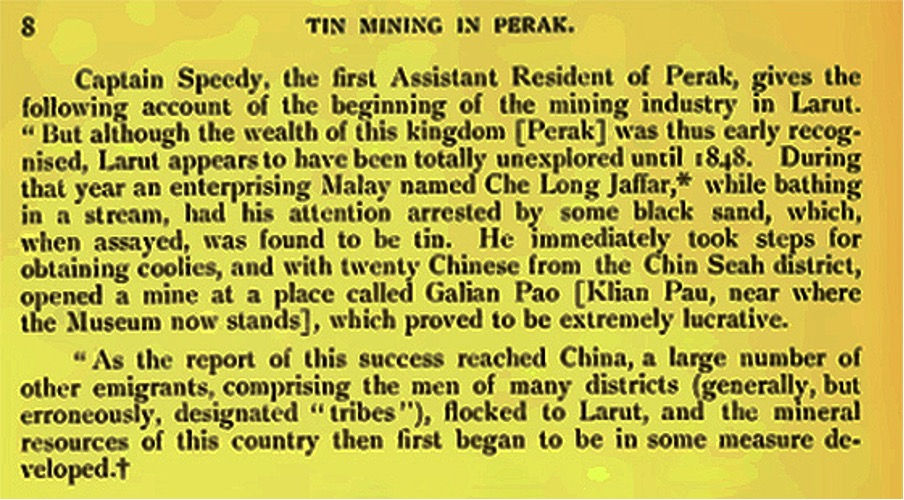
Taiping was the capital of Perak for 61 years, from 1875 to 1936. At that time, Taiping’s importance outshone any other town in Malaya. The Larut mines were among the richest and most important tin mining centres in the world, bringing in huge profits. This wealth flowed straight into the British administration’s coffers. With so much wealth at hand, they didn’t hold back . The British spent generously to turn Taiping into a model town.

Unlike other settlements that grew haphazardly, Taiping gave the British a rare opportunity - a clean slate to build a town from scratch. They laid out neat, straight roads, installed an advanced drainage system to cope with heavy rains, and put proper administrative order in place. It was, in many ways, their showcase of colonial town planning.

The British didn’t stop at infrastructure. They also invested in creating spaces of beauty and leisure. The Taiping Lake Gardens, built in 1880, were the first public gardens in Malaya. Once an abandoned tin mine, the site was transformed into a stunning park with lakes, walkways, and flowering trees - a reflection of Taiping’s prosperity and the British vision of a well-planned town.
Leisure also found its way up the slopes of Maxwell Hill (now Bukit Larut), where a hill station was established in 1884 to give officials and miners an escape from the tropical heat. Cool air, bungalows, and winding trails made it a favourite retreat. And in keeping with their love for sport, the British also introduced Malaya’s first golf course right there in Taiping.


Few people realise that Taiping was also home to Malaya’s very first airstrip - the Taiping Aerodrome, which opened in 1929. Long before larger airports in Ipoh or Penang took over, this small airfield was the gateway to the skies for the region, marking another ‘first’ in Taiping’s remarkable history.

From being a hotspot of violent clan wars to becoming the pride of colonial Malaya, Taiping’s transformation was dramatic. It wasn’t just luck - it was the perfect mix of rich resources, strategic importance, and the British drive to build something lasting.
But even the brightest spotlight can fade. As new towns rose and trade routes shifted, Taiping’s place at the centre of Perak’s story began to change. In Part 3 - Taiping: The Town of Firsts - and How Its Spotlight Faded - we trace the events and decisions that slowly dimmed its prominence, and how the legacy of its golden years still lingers today.


You are right Eng Seng. I've made the correction. Thanks for pointing out. 👍
Raja the photo of Main Rd in the 70s shld it be Kota Road where the clock tower is located 2day? Another excellent write up. Keep up the good work buddy. God bless